
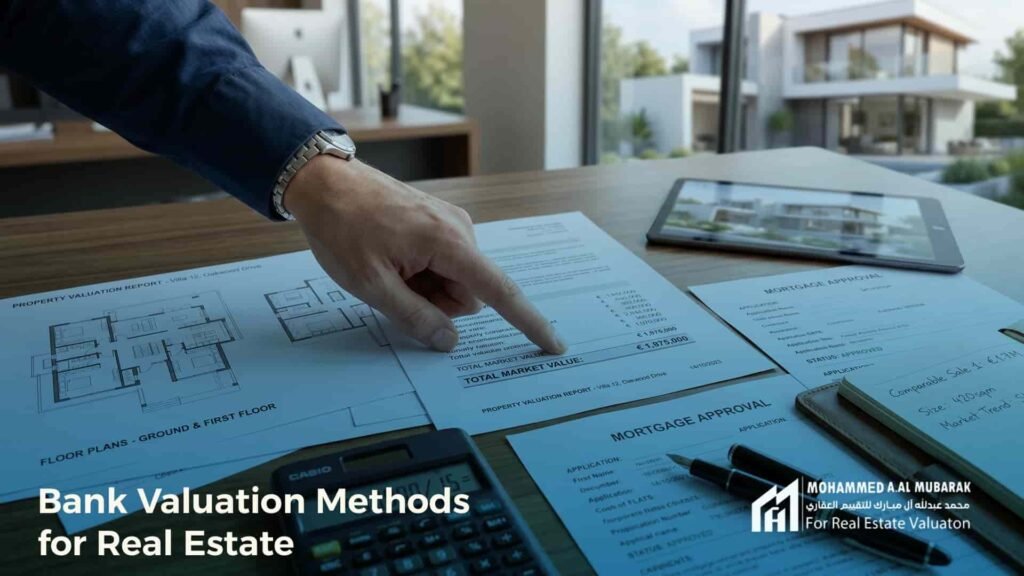
When applying for real estate financing, many clients face an important question: Does the price paid for the property match the value that the bank will approve? And will the bank grant the financing amount the client expects?
The truth is that banks do not evaluate property to satisfy the seller or the buyer. They evaluate it to manage lending risks according to strict and specific criteria. The way banks evaluate property differs completely from the estimate of the owner or the real estate broker, because it is based on protecting the value of the collateral, not on the property’s appearance or temporary market demand.
In this article, we explain the mechanism of property valuation for real estate financing step by step, and clarify the factors that can increase or decrease the property’s value from the bank’s perspective.
What Is Bank Property Valuation?
Bank property valuation is a precise and systematic technical process that aims to determine the fair market value of the property that the bank intends to finance. This valuation is not merely a personal opinion. It is an analytical study based on professional standards approved by the Saudi Authority for Accredited Valuers, known as TAQEEM.
This task is carried out by licensed and independent valuers who provide an official report reflecting the realistic value of the property under current market conditions. This helps both the bank and the client obtain an accurate and transparent view of the soundness of the investment.
How Do Banks Evaluate Property?
The valuation process is not carried out randomly. It follows a series of systematic steps that ensure accuracy and neutrality. These steps include:
1. Requesting Valuation from an Accredited Entity
The bank requests the valuation from licensed valuation companies listed among its approved providers. This ensures the independence of the valuation and confirms that the work complies with the standards of the Saudi Authority for Accredited Valuers, TAQEEM. It also prevents conflicts of interest and ensures professional outputs.
2. Conducting a Field Inspection of the Property
The valuer visits the property location to inspect it physically. During this visit, the valuer examines the structural condition of the building, the quality of finishes, and verifies that the area and technical specifications match the information stated in the title deed. The valuer also assesses the property’s expected useful life and maintenance condition.
3. Studying the Surrounding Real Estate Market
The valuer analyzes the geographical area surrounding the property and compares it with similar properties that were recently sold within the same area. The valuer also studies the level of supply and demand, as well as the impact of nearby services and infrastructure on the final value.
4. Applying Real Estate Valuation Methods
The valuer relies on specific scientific methodologies according to the type of property:
Market Comparison Approach:
This is the most common method for residential properties. It depends on recent sale prices of similar properties.
Cost Approach:
This method is often used for new buildings or specialized assets. It is based on calculating the current cost of reconstruction, then deducting depreciation.
Income Approach:
This method is used for investment properties that generate rental income. The value is calculated based on the property’s income-generating capacity.
5. Issuing the Real Estate Valuation Report
The final output of the process is a detailed report that includes an accurate description of the property, the valuation methodology used, field photos, and the estimated fair market value. This report is sent directly to the bank to serve as the main reference for approving the financing amount.
What Factors Affect Bank Property Valuation?
Real estate valuation is not based on random estimates. It is subject to a careful analysis of several key factors that help determine the fair market value. The most important factors include:
Geographic Location
Location is considered the most influential factor. It determines the attractiveness of the property, its proximity to key facilities, and the ease of access to it, all of which directly affect its value.
Land and Building Area
Area is not limited to square meters only. It also includes how efficiently the space is used and how suitable it is for the property’s intended purpose.
Building Age and Technical Condition
Newer properties are often more in demand. However, the overall structural condition, level of maintenance, and the presence of any construction defects play a major role in adjusting the value.
Quality of Finishes
The quality of materials used in construction and final finishing affects the property’s useful life and attractiveness, which can increase its estimated value.
Availability of Services and Infrastructure
The property’s proximity to schools, mosques, markets, and the availability of water, electricity, and sewage networks can improve its classification and raise its value.
Legal Status of the Property
The legal status is a cornerstone of any valuation process. It includes:
Title Deed:
Ensuring that the electronic title deed is valid and that its information is clear.
Licenses:
Ensuring that the property complies with approved building permits.
Violations:
Ensuring that the property is free from construction or regulatory violations that may affect its ownership or use.
Why Is the Bank’s Valuation Sometimes Lower Than the Asking Price?
This point raises many questions among clients. In reality, the valuer follows a scientific methodology to reach the fair market value, and this value may differ from the seller’s asking price for several objective reasons.
Overpricing
The seller may set the price based on personal expectations or private costs, while the valuation reflects the price that a typical buyer would pay under actual market conditions.
Real Estate Market Changes
Valuation is based on recent and documented data. However, the market may sometimes be slow to absorb changes, making the seller’s asking price higher than the current market reality.
Lack of Suitable Comparables
In some cases, there may not be enough recent sales of similar properties within the same area. This may lead the valuer to take a more conservative approach to ensure the safety of the financing decision.
Technical or Legal Observations
Any structural defects, building violations, or missing permits can directly reduce the market value of the property due to the risks associated with them.
Reliance on Market Value
Bank property valuation depends on verifiable market value. It does not take into account the emotional value the owner may attach to the property or uncertain future expectations of price increases.
The Importance of Hiring an Accredited Real Estate Valuer Before Applying for Financing
Before taking your first step toward the bank, hiring a professional real estate valuer may be one of the most practical decisions. Here is why:
Knowing the Real Value of the Property
A professional valuation helps you identify the fair price and avoid purchasing a property at an inflated value.
Avoiding a Financing Gap
When you know the real value of the property, you avoid the surprise that may occur if the bank’s valuation comes lower than expected, which may require you to provide additional cash.
Supporting Negotiations with the Seller
A professional valuation report gives you a stronger negotiating position based on clear facts and accurate figures.
Speeding Up Financing Procedures
Approaching the bank with a clear valuation and complete documents can save time and accelerate the approval process.
Understanding how banks evaluate property gives you deeper insight into the steps that support the success of your financing transaction. Valuation is not just a number. It is a scientific analysis based on market data and the actual technical condition of the property.
At Mohammed Abdullah Al Mubarak Real Estate Valuation Company, we are committed to providing real estate valuation reports that are accurate, neutral, and highly professional, in line with approved standards. If you are planning to have your property valued, our team is ready to help you make informed decisions., our team is ready to help you make well-informed decisions.
Contact us today to get accredited real estate valuation services.
Frequently Asked Questions
Can I Object to the Bank’s Property Valuation Result?
Yes. If you have proof that essential data was not considered or that there are technical errors in the report, you can contact the valuation entity through the bank and request a review of the report based on clear and documented reasons.
How Does the Age of the Property Affect Its Bank Valuation?
Age has a significant impact on value. Newer properties are often more in demand and require less maintenance, which increases their value. However, comprehensive renovation and restoration works may raise the value of older properties.
Is Bank Property Valuation the Same as Valuation for Personal Sale Purposes?
The scientific principles are the same. However, a report prepared for the bank is subject to specific requirements related to mortgage and financing standards, while valuation for personal sale purposes may focus more on achieving the best possible price in the current market.
Why Does the Bank Not Accept Valuation from Any Ordinary Real Estate Office?
Banks require reports from valuers accredited by the Saudi Authority for Accredited Valuers to ensure compliance with professional and ethical standards, complete neutrality, and the prevention of conflicts of interest. These standards are not guaranteed by unlicensed offices.